After several weeks traveling around Indonesia, we returned to Bali one last time. Five days between Uluwatu and Seminyak, without trying to fill the days, just to enjoy the island a little longer before turning the page.
Uluwatu is known for its immense cliffs, its wild beaches and its very surfing atmosphere. We took the scooter and spent several days exploring the south of Bali, stopping as needed to discover the different landscapes of the region. Between the roads lined with vegetation, the cliffs that fall directly into the ocean and the small hidden beaches below, the place really has a special atmosphere.
We notably discovered Nyang Nyang Beach, a huge sandy beach accessible after a descent through the cliff. The place was much quieter than other beaches in Bali and almost made you forget the hustle and bustle of the rest of the island.
Another moment that we particularly liked was the sunset over Suluban Beach. Sitting in one of the bars at the top of the cliffs, a beer in hand, we watched the surfers go down into the water to face the big waves of the spot, while the sun disappeared behind the ocean. One of those simple moments that sums up the atmosphere of Uluwatu well.
We also took a detour to Garuda Wisnu Kencana, a gigantic 121 meter statue representing the god Vishnu riding Garuda, a mythological creature resembling an eagle. What is quite impressive is that you can see it appearing in the distance when you walk in the south of Bali. Situated in the middle of an immense plain, with few buildings around, it seems almost unreal. And even knowing its dimensions, we remain surprised once we arrive right in front.
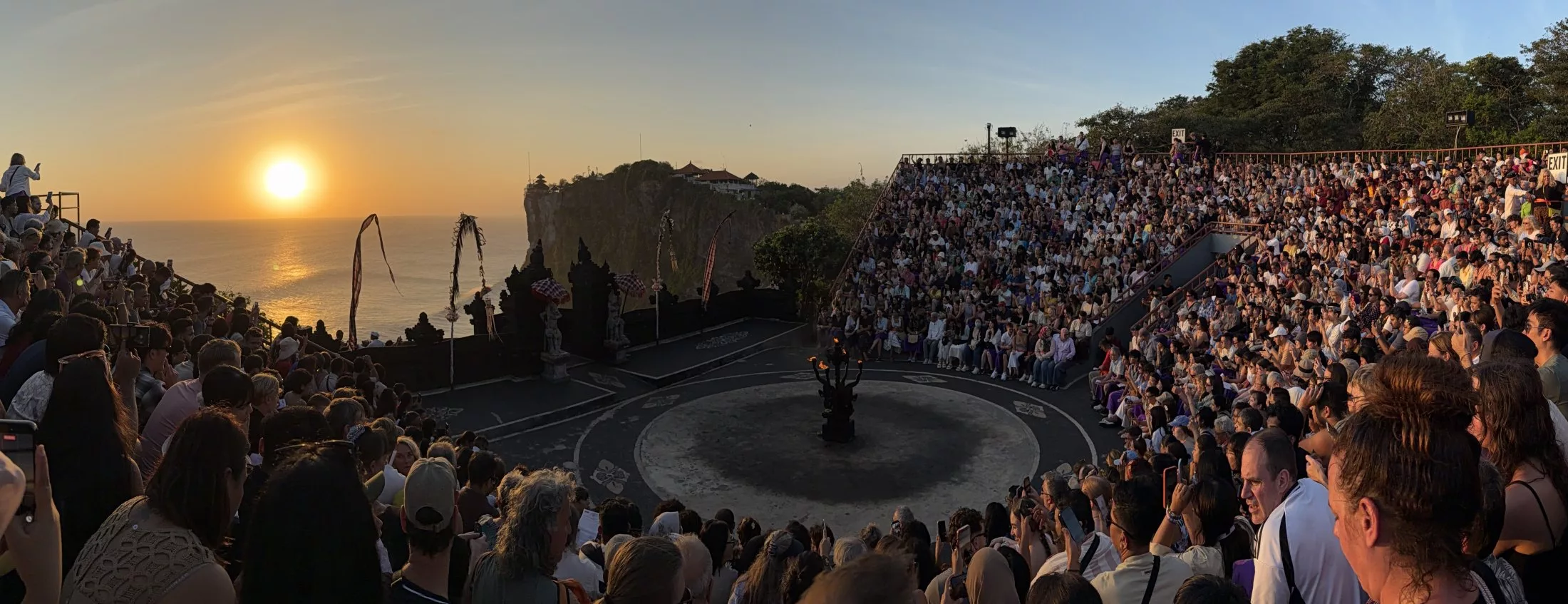
It is also impossible to pass through Uluwatu without visiting its famous temple perched on the edge of the cliffs. Every evening, Kecak dance performances are held at sunset. Even if the place is very touristy, the scenery remains magnificent: the temple, the ocean below and the spectacle that unfolds with the sun descending behind the cliffs.
The temple is also known for its numerous macaques, real little professional thieves. Glasses, phones or other items left unattended can disappear in seconds. We saw several tourists panicking trying to get their belongings, while the monkeys seemed to know perfectly well what they were doing.
After Uluwatu, two nights in Seminyak. We took the opportunity to explore a little of the neighborhood's LGBT scene, reputed to be the most visible in Bali. A few dedicated bars, a gay hotel, a concentration of places which make Seminyak a place where the community has clearly found its place on the island. It was nice to see it, and the welcome was warm. Honestly, we're not going to pretend that the atmosphere rivals that of a truly queer destination like Bangkok or Barcelona. But that's not really what we were looking for either. It was more of a curiosity, a little parenthesis in the journey, and a reminder that even in a country where LGBT rights are non-existent, or even in decline, spaces are still being created, discreet but very real.
This last stage may not have been the most spectacular of the trip, but it came at the right time. After several intense weeks across Indonesia, it was a nice way to slow down before setting off on a new adventure.
This is how our adventure in Indonesia ended. From the orangutans of Sumatra to the dragons of Komodo, from the volcanoes of Java to the seabed of Sulawesi, via the beaches of Lombok and the landscapes of Bali, this country will have offered us an incredible diversity of experiences. A journey full of discoveries, encounters and memories that we will keep for a long time.